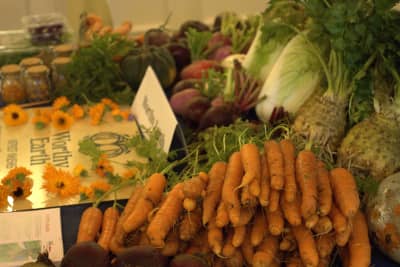
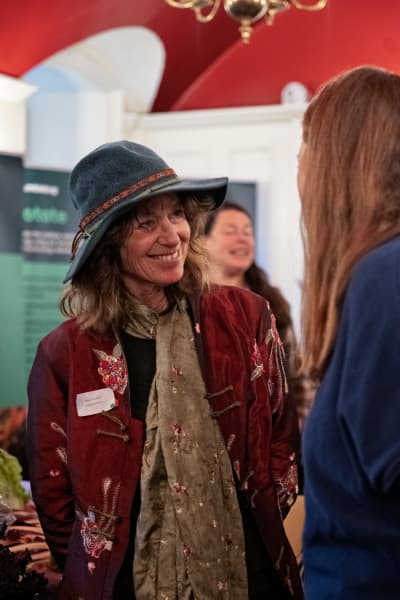
Imagine two days of high energy, with multiple sessions taking place across nine spaces in and around a town hall. Delegates meet, convene sessions, share knowledge – and leave with a renewed sense of “active hope”, as one of the organisers termed it.
This is the Oxford Real Farming Conference, which takes place every year in Oxford City. It was set up in 2009 by the Real Farming Trust, a charity that connects and supports people who are transforming the food system, when a small band of people got together in an upstairs room in town to discuss the farming crisis. They believed that there was a better way to farm.
Seventeen years on and this time 2,000 people descended on Oxford – two thirds of whom were under 35 – to learn about agroecological ways of farming. And learn they did.
Here are some highlights from our team at Good Food Oxfordshire and OxFarmToFork:
ENERGY, TENSION & MOTIVATIONS TO FARM DIFFERENTLY
Jenny Ekelund, Good Food Oxfordshire’s new CEO:
“The movement has formidable energy! There was a huge amount of energy and enthusiasm at the sessions I attended. It was great to see such a range of interested people there: farmers, growers, activists, journalists, policymakers, funders and researchers from around the world bringing different perspectives and (for the most part) avoiding the usual siloed thinking.
There was some tension in the sessions I attended between what is needed to address hunger/food injustice and the immediate symptoms of the current wasteful system (food distribution charities) and the deeper work that is needed to fix the broken system/address root causes.
Finally, from the farmers and growers I heard speak, there was an interesting mix of people who felt strongly motivated to farm agroecologically through a sense of connection to the land/nature (in some cases spiritual), and those who approached their work with burning scientific curiosity to add to the wider body of knowledge. In both cases there was clearly a deep commitment to growing, even when it was very challenging.”
THE VITAL ROLE OF THE DUNG BEETLE
Janie Bickersteth, OxFarmToFork Project Lead:
“I learnt about the vital role the dung beetle has on any farm with animals. These ‘tunnelers’ drag dung deep into the soil, thus improving the soil and removing the dung from the surface, where it can be a breeding ground for pests. They are immensely strong, pulling 1,000 times their own body weight, the equivalent of a person pulling six double decker buses full of people!
I also discovered that Denmark has normalised organic produce, by establishing at least 50% organic in public procurement and developing long term contracts for organic growers.
I learnt about one UK organic wholesaler in the southeast who is supplying produce to 300 London restaurants.
I had a moment in the sun with the Todoli Citrus Foundation, who grow 500 varieties of citrus organically on only 10 acres of land on the coast of southern Spain; I dreamt of importing these to OxFarmToFork to fill the Hungry Gap.”
INFORMATION SHARING AND COMMUNICATION
Rose Birch, OxFarmToFork Logistics and Data Coodinator:
“Across both days, my four highlights were around information sharing and communication.
Hearing the phrase '4 meals away from anarchy' helped position why government is nervous of big food system changes – and why so much change can come from the ground up.
'Chefs don’t talk farmer and farmers don’t talk chef' was another phrase that landed. How can we help to bridge that gap so that buying vegetables isn’t like buying a widget?
What is good food? How can we communicate this and how can we enable students or consumers to be able to ask for and expect good more often? Our OxFarmToFork project can enable that choice.
Finally, there was lots of thinking about our communication around advertising, how that affects all of us, and how in South America they have tackled this head on with logos clarifying the nutritional value on the packaging of all processed foods – in a similar way to cigarettes.”
"What if Oxfordshire could feed Oxfordshire?" That’s the question driving OxFarmToFork. We’re moving away from wasteful global systems and back to a model built on collaboration and fair pay for farmers.
Whether you’re a grower looking for a fair market or a supporter of a resilient local food system, we want to hear from you. Get in touch at oxfarmtofork@gfo.org.uk